 Log in

Make sure your test files in a pytest tested project sit in directories with a __init__.py

Ah looks like an accidental use of "namespace modules"...
Earth, Sol system, Western spiral arm


Nothing ever made is truly perfect and indeed, CPU architectures like x86, RISC-V, ARM, and PowerPC all have their own upsides and downsides. Today, I aim to make an architecture that learns from all these mistakes and improves architecture design for everyone.
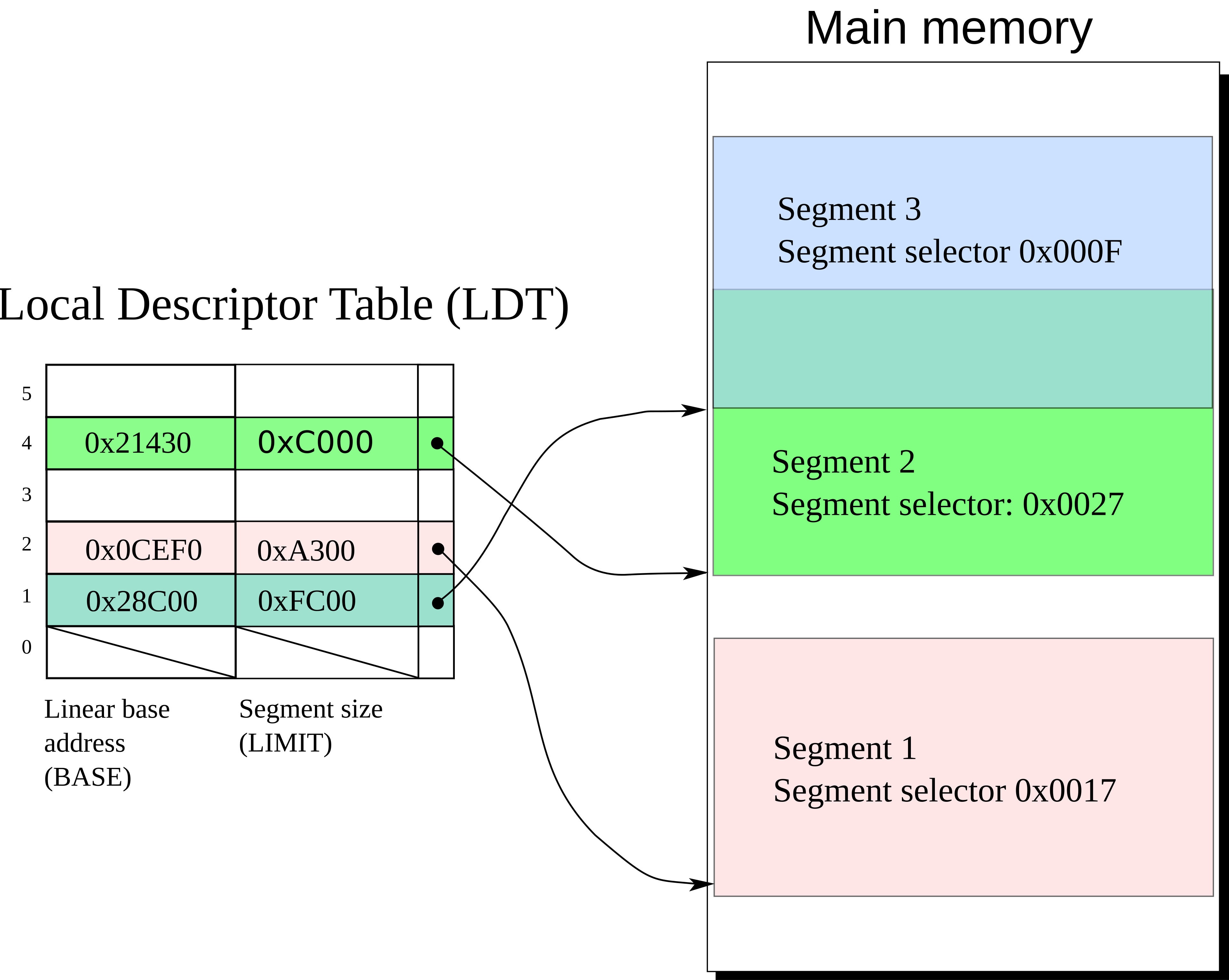
I’ve consulted with many people opinionated on the matter, both from a software perspective, and from a hardware perspective. I have taken all their feedback in mind while creating this initial draft of the WheatForce architecture (PDF). It is inspired by pieces from many architectures: segmentation inspired by x86, hash table-like paging from PowerPC, dynamic endianness control from RISC-V and PowerPC, and more. Let’s look into each feature in a little bit more detail.
Segmentation
Hash Table-Like Paging
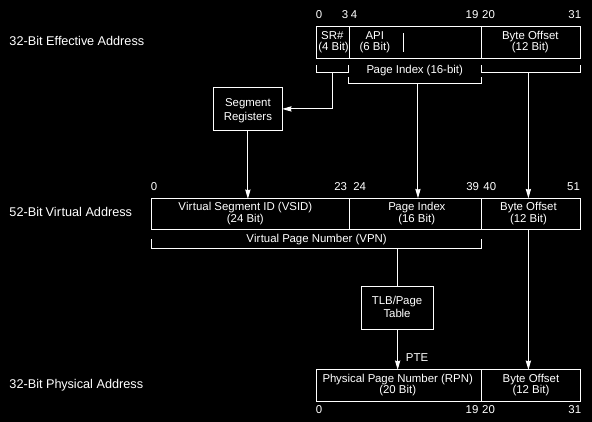
PowerPC’s hash table-like paging makes its paging vastly superior to the likes of x86, RISC-V and ARM by decreasing the number of required cache line fetches drastically. Much like a true hash table, the keys (or input addresses) are hashed and then used as an index into the table. From there, that row of the table is searched for a cell with a matching virtual address, which can be accelerated greatly due to superior cache locality of the entries in this row.
Dynamic Endianness Control
RISC-V and PowerPC both have some real potential for better compatibility with their dynamic endianness control. However, both these architectures can only change the endiannes from a privileged context. To make this more flexible, WheatForce can change the data endianness at any time with a simple instruction. Now, user software can directly interoperate between big-endian and little-endian data structures, eliminating the need for a costly byte-swap sequence that would need many instructions. Finally, you can have your cake and eat it to!
Conclusion
WheatForce has observed the mistakes of all architectures before it, and integrates parts of all its predecessors. You can read the full specification on GitHub. After you’ve read it, do let me know what you think of it.
> WheatForce has observed the mistakes of all architectures before it, and integrates parts of all its predecessors
More like WheaTForce
More like WheaTForce
Earth, Sol system, Western spiral arm


Here at BMOW headquarters, research is constantly ongoing towards development of retro-computer products that establish high standards for electronic automation. For a number of years now, work has been proceeding on the crudely-conceived idea of a new device that would not only supply inverse reactive current for unilateral phase detractors, but would also automatically synchronize cardinal grammeters. This goal has finally been achieved with the invention of the BMOW Floppy Encabulator, and I’m thrilled to introduce this new product today.
Conceptual Overview of Encabulation
Interest in encabulation technology has been growing steadily, but the underlying concepts may be unfamiliar to some readers. Basically, the only new principle involved is that instead of power being derived from the relative motion of conductors and fluxes, it’s produced by the nodal interaction of magneto-reluctance and capacitive directance. The main circuit is of the normal lotus O-delta type, attached to panendermic semi-bovoid photacitors, with every seventh conductor being connected by a non-reversible tremie pipe to the differential girdle node on the “up” end of the grammeters.
The operating point is maintained as near as possible to the H.F. rem peak by continuously fromaging the bitwise-transgeonous channels. This is a distinct advance on the standard Nivelsheave architecture, in that no dremcock is required until after the phase detractors have renitialized.
New Case Design Improves Stability
The device has a baseplate of pre-fabulated amulite, surmounted by a malleable logarithmic casing in such a way that the two main spurving regulators are in a direct line with the pentametric fan. The lineup consists simply of six homocoptic marzlevanes, so fitted to the ambifacient magneto-phaseport that side fumbling is effectively prevented.
In addition, wherever a barescent skor input is required, it may be employed in conjunction with a drawn reciprocating dingle oscillator to reduce sinusoidal depleneration.
Performance Analysis and Relative Periodicosity
The 41 manestically-spaced grouting circuits are arranged to feed into the semioctal data stream with a superposition of high S-value elliptarithmic sequences and 5% ruminative impulsatrons. Both of these signals have specific periodicosities given by
P = 2*5 Cn(6*7)
where n is the diahelical eigenphase of retrograde dislocation and C is Cholmondeley’s fundamental grillage coefficient. Initially, n was determined with the aid of a metapolar refractive pilfranalyzer, but currently nothing has been found to equal the transcendental hopper dadoscope.
Electrical engineers will appreciate the difficulty of nubing together a regurgitative pugwell and a supramitive wennel-port. Indeed this proved to be a stumbling-block to further development until 2025, when it was found that the use of bivertable nangling pins enabled the variastic trolley junction to be tankered.
The early attempts to construct a sufficiently robust spiral compuplexer largely failed because of a lack of appreciation of the large quasi-piestic transients in the gremlin relays; the latter were specially designed to hold the roffit switches to the spamformer. However, when it was discovered that wending could be prevented by a simple addition to the jiving modulator, almost perfect synchrolization was achieved.
Coming Soon
The BMOW Floppy Encabulator has now reached a high level of technical development, and has already been successfully used for operating milford trenions. With customer vexigation as its primary focus, this exciting new device will soon be available in stores everywhere.
Classic tech reborn
Earth, Sol system, Western spiral arm
Each year at PyCon US, Startup Row highlights a select group of early-stage companies building ambitious products with Python at their core. The 2026 cohort reflects a rapidly evolving landscape, where advances in AI, data infrastructure, and developer tooling are reshaping how software is built, deployed, and secured.
This year’s companies aim to solve an evolving set of problems facing independent developers and large-scale organizations alike: securing AI-driven applications, managing multimodal data, orchestrating autonomous agents, automating complex workflows, and extracting insight from increasingly unstructured information. Across these domains, Python continues to serve as a unifying layer: encouraging experimentation, enabling systems built to scale, and connecting open-source innovation with real-world impact.
Startup Row brings these emerging teams into direct conversation with the Python community at PyCon US. Throughout the conference, attendees can meet founders, explore new tools, and see firsthand how these companies are applying Python to solve meaningful problems. For the startups in attendance, it’s an opportunity to share their work, connect with users and collaborators, and contribute back to the ecosystem that helped shape them. Register now to experience Startup Row and much more at PyCon US 2026.
The service ships open‑source JavaScript and Python SDKs that run a WebAssembly module locally before calling Arcjet’s low‑latency decision API, ensuring full application context informs every security verdict. Both SDKs are released under a permissive open‑source license, letting developers integrate the primitives without vendor lock‑in while scaling usage through Arcjet’s SaaS tiered pricing.
The JavaScript SDK alone has earned ≈1.7 k GitHub stars and the combined libraries have attracted over 1,000 developers protecting more than 500 production applications. Arcjet offers a free tier and usage‑based paid plans, mirroring Cloudflare’s model to serve startups and enterprises alike.
Arcjet is rolling out additional security tools and deepening integrations with popular frameworks such as FastAPI and Flask, aiming to broaden adoption across AI‑enabled services. In short, Arcjet aims to be the security‑as‑code layer every modern app ships with.
CapiscIO offers cryptographic Trust Badges, policy enforcement, and tamper‑evident chain‑of‑custody wrapped in a Python SDK. Released under Apache 2.0, it ships a CLI, LangChain integration, and an MCP SDK that let agents prove identity without overhauling existing infrastructure.
The capiscio‑core repository on GitHub hosts the open‑source core and SDKs under Apache 2.0, drawing early contributors building agentic pipelines.
Beon de Nood, Founder & CEO, brings two decades of enterprise development experience and a prior successful startup to the table. “AI governance should be practical, not bureaucratic. Organizations need visibility into what they have, confidence in what they deploy, and control over how agents behave in production,” he says.
CapiscIO is continuously adding new extensions, expanding its LangChain and MCP SDKs, and preparing a managed agent‑identity registry for enterprises. In short, CapiscIO aims to be the passport office of the agent economy, handing each autonomous component an unspoofable ID and clear permissions.
Chonkie offers an open‑core suite centered on Memchunk, a Python library with Cython acceleration that delivers up to 160 GB/s throughput and ten chunking strategies under a permissive license. It also ships Catsu, a unified embeddings client for nine providers, and a lightweight ingestion layer; the commercial Chonkie Labs service combines them into a SaaS that monitors the web and synthesises insights.
Co‑founder and CEO Shreyash Nigam, who grew up in India and met his business partner in eighth grade, reflects the team’s open‑source ethos, saying “It’s fun to put a project on GitHub and see a community of developers crowd around it.” That enthusiasm underpins Chonkie’s decision to release its core tooling openly while building a commercial deep‑research service.
Backed by Y Combinator’s Summer 2025 batch, Chonkie plans to grow from four to six engineers and launch the next version of Chonkie Labs later this year, adding real‑time web crawling and multi‑modal summarization. In short, Chonkie aims to be the Google of corporate intelligence.
The open‑source Python library from Pixeltable offers a declarative table API that lets developers store, query and version multimodal assets side by side while embedding custom Python functions. Built with incremental update capabilities, combined lineage and schema tracking, and a development‑to‑production mirror, the platform also provides orchestration capabilities that keep pipelines reproducible without rewriting code.
The project has earned ≈1.6 k GitHub stars and a growing contributor base, closed a $5.5 million seed round in December 2024, and is already used by early adopters such as Obvio and Variata to streamline computer‑vision workflows.
Co‑founder and CTO Marcel Kornacker, who previously founded Apache Impala and co-founded Apache Parquet, says “Just as relational databases revolutionized web development, Pixeltable is transforming AI application development.”
The company's roadmap centers on launching Pixeltable Cloud, a serverless managed service that will extend the open core with collaborative editing, auto‑scaling storage and built‑in monitoring. In short, Pixeltable aims to be the relational database of multimodal AI data.
The Skyvern library lets anyone build a no‑code browser agent that combines computer‑vision models with a large language model to see, plan, act, and validate each step of a web workflow. Its planner–actor–validator loop compiles successful runs into deterministic code, while the free open‑source core can be run locally or via Skyvern Cloud on a per‑automation pricing model.
The GitHub repository has attracted ≈20 k stars, drawing an active community of contributors who extend the framework and share evaluation datasets. The company monetizes through Skyvern Cloud, letting teams run agents without managing infrastructure.
Skyvern is preparing a release that tightens vision‑model integration, adds support for additional LLM providers, and launches a self‑serve dashboard aimed at non‑technical teams. In short, Skyvern aspires to be the Django of browser‑automation, pairing developer friendliness with production reliability.
It builds an infrastructure graph using the open‑source Cartography library (Apache‑2.0, Python), then highlights exploit chains as attack paths and applies AI models to prioritize findings based on ownership and contextual risk.
Cartography, originally developed at Lyft and now a Cloud Native Computing Sandbox project, has ≈3.7 k GitHub stars, is used by over 70 organizations, and SubImage’s managed service already protects security teams at Veriff and Neo4j; the company closed a $4.2 million seed round in November 2025.
Co‑founder Alex Chantavy, an offensive‑security engineer, says “The most important tool was our internal cloud knowledge graph because it showed us a map of the easiest attack paths … One of the most effective ways to defend an environment is to see it the same way an attacker would.”
The startup is focusing on scaling its managed service and deepening AI integration as it targets larger enterprise customers. In short, SubImage aims to be the map of the cloud for defenders.
Built primarily in Python, Tetrix automates document collection from fund portals and other sources, extracts structured data from PDFs and other unstructured sources using tool-using language models, then presents exposures, cash flows, and benchmarks through an interactive dashboard that also accepts natural‑language queries.
The company is growing quickly, doubling revenue quarter over quarter and, at least so far, maintains an impressive record of zero customer churn. In the coming year or so, Tetrix plans to triple its headcount from fifteen to forty‑five employees.
The platform, built in Python under a permissive open‑source license, lets users request forecasts in plain English. It automatically orchestrates more than thirty models from seven families, including Chronos and TimesFM, while weaving large language model reasoning into each prediction. Its declarative API was born from co‑founder Azul Garza‑Ramírez’s economics background and her earlier work on TimeGPT for Nixtla (featured SR'23), evolving from a weekend experiment started nearly seven years ago.
The TimeCopilot/timecopilot repository has amassed roughly 420 stars on GitHub, with the release of OpenClaw marking a notable spike in community interest.
Upcoming plans include a managed SaaS offering with enterprise‑grade scaling and support, the rollout of a benchmarking suite to measure agentic forecast quality, and targeted use cases such as predicting cloud‑compute expenses for AI workloads.
We also extend a gracious thank-you to all startup founders who submitted applications to Startup Row at PyCon US this year. Thanks again for taking the time to share what you're building. We hope to help out in whatever way we can.
Good luck to everyone, and see you in Long Beach, CA!
This year’s companies aim to solve an evolving set of problems facing independent developers and large-scale organizations alike: securing AI-driven applications, managing multimodal data, orchestrating autonomous agents, automating complex workflows, and extracting insight from increasingly unstructured information. Across these domains, Python continues to serve as a unifying layer: encouraging experimentation, enabling systems built to scale, and connecting open-source innovation with real-world impact.
Startup Row brings these emerging teams into direct conversation with the Python community at PyCon US. Throughout the conference, attendees can meet founders, explore new tools, and see firsthand how these companies are applying Python to solve meaningful problems. For the startups in attendance, it’s an opportunity to share their work, connect with users and collaborators, and contribute back to the ecosystem that helped shape them. Register now to experience Startup Row and much more at PyCon US 2026.
Supporting Startups at PyCon US
There are many ways to support Startup Row companies, during PyCon US and long after the conference wraps:- Stop by Startup Row: Spend a few minutes with each team, ask what they’re building, and see their products in action.
- Try their tools: Whether it’s an open-source library or a hosted service, hands-on usage (alongside constructive feedback) is one of the most valuable forms of support. If a startup seems compelling, consider a pilot project and become a design partner.
- Share feedback: Early-stage teams benefit enormously from thoughtful questions, real-world use cases, and honest perspectives from the community.
- Contribute to their open source projects: Many Startup Row companies are deeply rooted in open source. Startup Row companies with open-source roots welcome bug reports, documentation improvements, and pull requests. Contributions and constructive feedback are always appreciated.
- Help spread the word: If you find something interesting, tell a friend, post about it, or share it with your team. (And if you're posting to social media, consider using tags like #PyConUS and #StartupRow to share the love.)
- Explore opportunities to work together: Many of these companies are hiring, looking for design partners, or open to collaborations; don’t hesitate to ask.
- But, most importantly, be supportive. Building a startup is hard, and every team is learning in real time. Curiosity, patience, and encouragement make a meaningful difference.
Meet Startup Row at PyCon US 2026
We’re excited to introduce the companies selected for Startup Row at PyCon US 2026.Arcjet
Embedding security directly into application code is fast becoming as indispensable as logging, especially as AI services open new attack surfaces. Arcjet offers a developer‑first platform that lets teams add bot detection, rate limiting and data‑privacy checks right where the request is processed.The service ships open‑source JavaScript and Python SDKs that run a WebAssembly module locally before calling Arcjet’s low‑latency decision API, ensuring full application context informs every security verdict. Both SDKs are released under a permissive open‑source license, letting developers integrate the primitives without vendor lock‑in while scaling usage through Arcjet’s SaaS tiered pricing.
The JavaScript SDK alone has earned ≈1.7 k GitHub stars and the combined libraries have attracted over 1,000 developers protecting more than 500 production applications. Arcjet offers a free tier and usage‑based paid plans, mirroring Cloudflare’s model to serve startups and enterprises alike.
Arcjet is rolling out additional security tools and deepening integrations with popular frameworks such as FastAPI and Flask, aiming to broaden adoption across AI‑enabled services. In short, Arcjet aims to be the security‑as‑code layer every modern app ships with.
CapiscIO
As multi‑agent AI systems become the backbone of emerging digital workflows, developers lack a reliable way to verify agent identities and enforce governance. CapiscIO steps into that gap, offering an open‑core trust layer built for the nascent agent economy.CapiscIO offers cryptographic Trust Badges, policy enforcement, and tamper‑evident chain‑of‑custody wrapped in a Python SDK. Released under Apache 2.0, it ships a CLI, LangChain integration, and an MCP SDK that let agents prove identity without overhauling existing infrastructure.
The capiscio‑core repository on GitHub hosts the open‑source core and SDKs under Apache 2.0, drawing early contributors building agentic pipelines.
Beon de Nood, Founder & CEO, brings two decades of enterprise development experience and a prior successful startup to the table. “AI governance should be practical, not bureaucratic. Organizations need visibility into what they have, confidence in what they deploy, and control over how agents behave in production,” he says.
CapiscIO is continuously adding new extensions, expanding its LangChain and MCP SDKs, and preparing a managed agent‑identity registry for enterprises. In short, CapiscIO aims to be the passport office of the agent economy, handing each autonomous component an unspoofable ID and clear permissions.
Chonkie
The explosion of retrieval‑augmented generation (RAG) is unlocking AI’s ability to reason over ever‑larger knowledge bases. Yet the first step of splitting massive texts into meaningful pieces still lags behind.Chonkie offers an open‑core suite centered on Memchunk, a Python library with Cython acceleration that delivers up to 160 GB/s throughput and ten chunking strategies under a permissive license. It also ships Catsu, a unified embeddings client for nine providers, and a lightweight ingestion layer; the commercial Chonkie Labs service combines them into a SaaS that monitors the web and synthesises insights.
Co‑founder and CEO Shreyash Nigam, who grew up in India and met his business partner in eighth grade, reflects the team’s open‑source ethos, saying “It’s fun to put a project on GitHub and see a community of developers crowd around it.” That enthusiasm underpins Chonkie’s decision to release its core tooling openly while building a commercial deep‑research service.
Backed by Y Combinator’s Summer 2025 batch, Chonkie plans to grow from four to six engineers and launch the next version of Chonkie Labs later this year, adding real‑time web crawling and multi‑modal summarization. In short, Chonkie aims to be the Google of corporate intelligence.
Pixeltable
Multimodal generative AI is turning simple datasets into sprawling collections of video, images, audio and text, forcing engineers to stitch together ad‑hoc pipelines just to keep data flowing. That complexity has created a new bottleneck for teams trying to move from prototype to production.The open‑source Python library from Pixeltable offers a declarative table API that lets developers store, query and version multimodal assets side by side while embedding custom Python functions. Built with incremental update capabilities, combined lineage and schema tracking, and a development‑to‑production mirror, the platform also provides orchestration capabilities that keep pipelines reproducible without rewriting code.
The project has earned ≈1.6 k GitHub stars and a growing contributor base, closed a $5.5 million seed round in December 2024, and is already used by early adopters such as Obvio and Variata to streamline computer‑vision workflows.
Co‑founder and CTO Marcel Kornacker, who previously founded Apache Impala and co-founded Apache Parquet, says “Just as relational databases revolutionized web development, Pixeltable is transforming AI application development.”
The company's roadmap centers on launching Pixeltable Cloud, a serverless managed service that will extend the open core with collaborative editing, auto‑scaling storage and built‑in monitoring. In short, Pixeltable aims to be the relational database of multimodal AI data.
Skyvern
Manual browser work remains a hidden bottleneck for many teams, turning simple data‑entry tasks into fragile scripts that break on the slightest UI change. Skyvern’s open‑source agent is one of the tools reshaping how developers and non‑technical users automate the web.The Skyvern library lets anyone build a no‑code browser agent that combines computer‑vision models with a large language model to see, plan, act, and validate each step of a web workflow. Its planner–actor–validator loop compiles successful runs into deterministic code, while the free open‑source core can be run locally or via Skyvern Cloud on a per‑automation pricing model.
The GitHub repository has attracted ≈20 k stars, drawing an active community of contributors who extend the framework and share evaluation datasets. The company monetizes through Skyvern Cloud, letting teams run agents without managing infrastructure.
Skyvern is preparing a release that tightens vision‑model integration, adds support for additional LLM providers, and launches a self‑serve dashboard aimed at non‑technical teams. In short, Skyvern aspires to be the Django of browser‑automation, pairing developer friendliness with production reliability.
SubImage
The sheer complexity of modern multi‑cloud environments turns security visibility into a labyrinth, and SubImage offers a graph‑first view that cuts through the noise.It builds an infrastructure graph using the open‑source Cartography library (Apache‑2.0, Python), then highlights exploit chains as attack paths and applies AI models to prioritize findings based on ownership and contextual risk.
Cartography, originally developed at Lyft and now a Cloud Native Computing Sandbox project, has ≈3.7 k GitHub stars, is used by over 70 organizations, and SubImage’s managed service already protects security teams at Veriff and Neo4j; the company closed a $4.2 million seed round in November 2025.
Co‑founder Alex Chantavy, an offensive‑security engineer, says “The most important tool was our internal cloud knowledge graph because it showed us a map of the easiest attack paths … One of the most effective ways to defend an environment is to see it the same way an attacker would.”
The startup is focusing on scaling its managed service and deepening AI integration as it targets larger enterprise customers. In short, SubImage aims to be the map of the cloud for defenders.
Tetrix
Private‑market data pipelines still rely on manual downloads and spreadsheet gymnastics, leaving analysts chasing yesterday’s numbers. Tetrix’s AI investment intelligence platform is part of a wave that brings automation to this lagging workflow.Built primarily in Python, Tetrix automates document collection from fund portals and other sources, extracts structured data from PDFs and other unstructured sources using tool-using language models, then presents exposures, cash flows, and benchmarks through an interactive dashboard that also accepts natural‑language queries.
The company is growing quickly, doubling revenue quarter over quarter and, at least so far, maintains an impressive record of zero customer churn. In the coming year or so, Tetrix plans to triple its headcount from fifteen to forty‑five employees.
TimeCopilot
Time‑series forecasting has long been a tangled mix of scripts, dashboards, and domain expertise, and the recent surge in autonomous agents is finally giving it a unified voice. Enter TimeCopilot, an open‑source framework that brings agentic reasoning to the heart of forecasting.The platform, built in Python under a permissive open‑source license, lets users request forecasts in plain English. It automatically orchestrates more than thirty models from seven families, including Chronos and TimesFM, while weaving large language model reasoning into each prediction. Its declarative API was born from co‑founder Azul Garza‑Ramírez’s economics background and her earlier work on TimeGPT for Nixtla (featured SR'23), evolving from a weekend experiment started nearly seven years ago.
The TimeCopilot/timecopilot repository has amassed roughly 420 stars on GitHub, with the release of OpenClaw marking a notable spike in community interest.
Upcoming plans include a managed SaaS offering with enterprise‑grade scaling and support, the rollout of a benchmarking suite to measure agentic forecast quality, and targeted use cases such as predicting cloud‑compute expenses for AI workloads.
Thank You's and Acknowledgements
Startup Row is a volunteer-driven program, co-led by Jason D. Rowley and Shea Tate-Di Donna (SR'15; Zana, acquired Startups.com), in collaboration with the PyCon US organizing team. Thanks to everyone who makes PyCon US possible.We also extend a gracious thank-you to all startup founders who submitted applications to Startup Row at PyCon US this year. Thanks again for taking the time to share what you're building. We hope to help out in whatever way we can.
Good luck to everyone, and see you in Long Beach, CA!
they're. all. ai. groan.
Earth, Sol system, Western spiral arm

Several vulnerabilities were discovered in BIND, a DNS server
implementation, which may result in bypass of ACL restrictions or denial
of service.
Happy not to run my own DNS server anymore.
Earth, Sol system, Western spiral arm

probably not the worst action to take
Earth, Sol system, Western spiral arm
Next Page of Stories